
If you examine lifting equipment in Ireland, or you own cranes, telehandlers, hoists or lifting gear, you'll have come across the GA1. It's the form most competent persons use to record a thorough examination, and it's the certificate most customers expect to see.
This guide explains what the GA1 is, what goes in each part of it, how often equipment needs examining and what happens when a defect turns up. There's a free template and a sample certificate to download further down.
We're not lawyers or inspectors, so treat this as a practical overview. The regulations and the Health and Safety Authority have the final word.
What is the GA1 form?
The GA1 is the HSA's sample Report of Thorough Examination for lifting equipment. The current version is Revision 2012. It's used to record the thorough examination and testing of lifting equipment required by the Safety, Health and Welfare at Work (General Application) Regulations 2007.
The important point is that the GA1 is a sample, not a legal requirement in itself. The form says it isn't an approved or statutory form and that reports can be produced in other formats. What the law requires is that the report contains the particulars listed in Schedule 1, Part E of the regulations. So a report from an app or your own template is fine, as long as everything required is there.
Who fills it in?
The examination and the report must be done by a competent person. The Safety, Health and Welfare at Work Act 2005 treats someone as competent when they have enough training, experience and knowledge for the work involved. In practice that's usually an independent examiner or an engineer from a specialist inspection firm.
The employer or owner of the equipment is responsible for making sure the examinations happen on time and for acting on what the report says.
How often does lifting equipment need a thorough examination?
Schedule 1, Part B of the General Application Regulations sets the longest period allowed between thorough examinations. Here are some of the most common types of equipment:
| Equipment | Thorough examination at least every |
|---|---|
| Lifting accessories (chains, ropes, slings, shackles, hooks, spreader beams, vacuum lifters) | 6 months |
| Hoist or lift | 6 months |
| Mobile elevating work platform | 6 months |
| Other lifting machines used to lift people | 6 months |
| Crane | 12 months |
| Forklift truck | 12 months (6 if used to lift people) |
| Telehandler | 12 months (6 if used to lift people) |
| Other lifting machines used for materials only | 12 months |
Check the full Schedule for anything not listed here. A thorough examination is also needed:
- before equipment is first used, unless it's new, CE marked and hasn't been reassembled since it left the manufacturer
- after it's installed or assembled at a new site, where its safety depends on how it's put together
- after repairs or alterations that could affect its safety
- after something exceptional, such as an accident, a long period out of use or damage from bad weather
The competent person can also set a shorter period than the Schedule allows, for example for equipment that works hard or in a harsh environment, and must say why in writing.
What goes in each section of the GA1
Report details and the owner
The date of the examination, your reference number, the name and address of the employer or owner it was done for, a contact number and email, and the address where the examination took place.
The lifting equipment
Enough detail to identify the equipment beyond doubt: the type of equipment, make and model, serial number and year of manufacture. A fleet number helps too.
Safe working load configurations
The safe working load for each way the equipment is set up, following the manufacturer's instructions. For a crane or telehandler that means things like jib or boom length, radius, ballast, number of rope falls and height under the hook. The GA1 has room for three configurations, and you add another sheet if there are more.
Testing and thorough examination
Why the test or examination was done (for example a periodic examination within 12 months, or an examination after a repair), the details of any tests carried out, and the latest date for the next thorough examination. That date is the one customers care most about.
Defects
The GA1 separates defects into two kinds:
- A defect which is a danger to persons, with the repair needed, and whether immediate cessation of use has been advised.
- A defect which could become a danger to persons, with the repair needed and the timeframe for doing it.
There's also a box for any parts that couldn't be examined, which matters if a later problem turns up in one of them.
Competent person, certification and signatures
The name, address and qualifications of the competent person, the name and position of anyone authenticating the report, and signatures for both the examiner and the employer receiving the report. The form finishes with a short checklist confirming the examination was done as prescribed, defects were identified, it was done by a competent person and the particulars are correct.
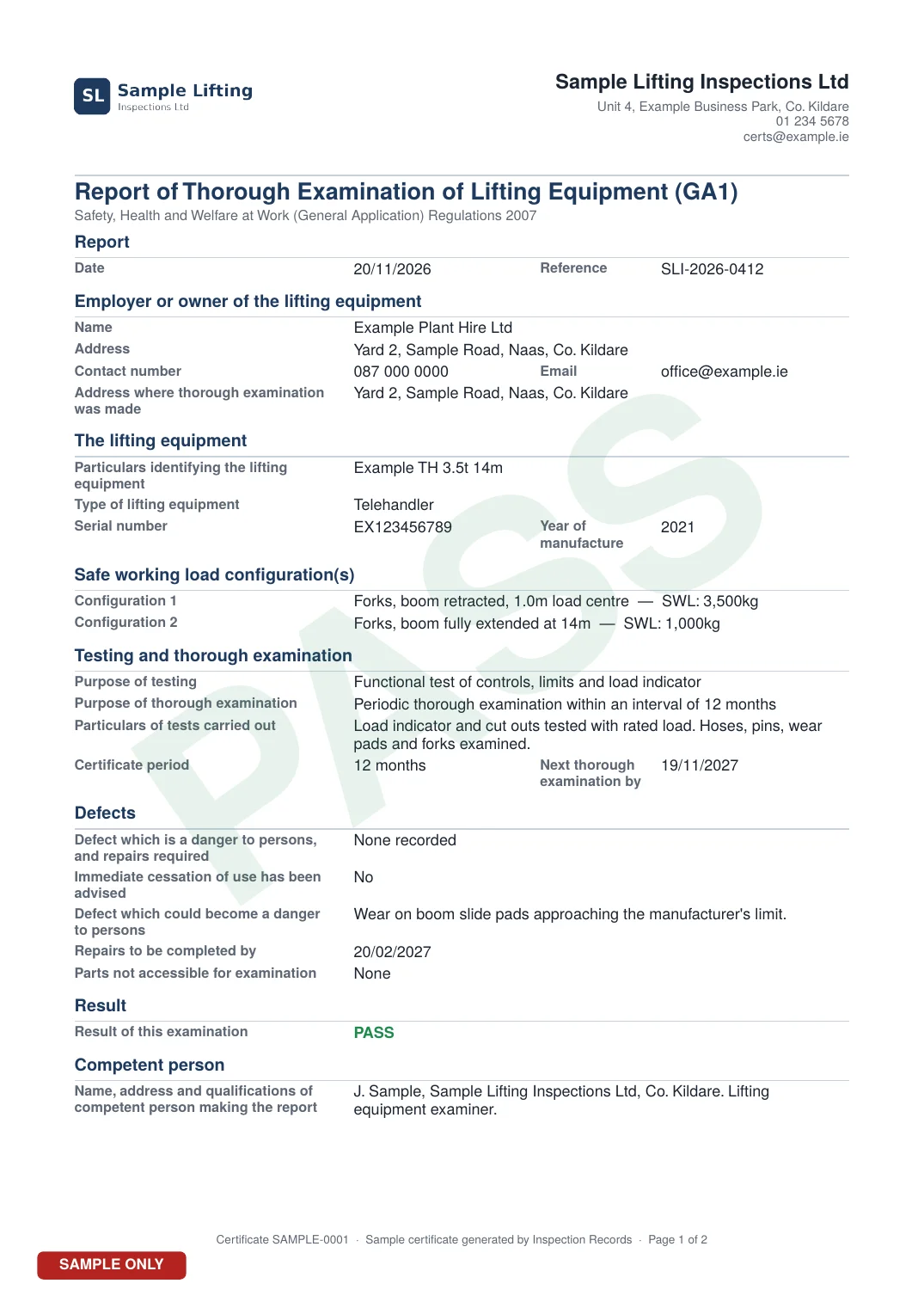
Here's what a finished GA1 certificate looks like
This is a sample produced by Inspection Records, our GA1 inspection app, using made-up details. It covers everything above, with the safe working loads, a defect that could become a danger with its repair date, the pass result and the competent person's saved signature on page two.
Free GA1 template and sample certificate
Our free template follows the HSA's GA1 form section by section, with one extra box for the date of the last examination, which the regulations ask for where it's known. You can fill it in on a computer, since the boxes and tick boxes are editable, or print it and fill it in by hand. It isn't an official HSA form, but you don't need one.
Download the free GA1 template (PDF) View the sample certificateWhen a defect is serious
If the competent person advises that the equipment must stop being used immediately, two things follow. The owner must not use it until the repair is done and it has been examined again. And the competent person must send a copy of the report to the HSA within 20 days of the examination.
For a defect that could become dangerous, the repair must be done within the timeframe on the report. It's worth having a system that reminds you as that date gets close, because a missed repair date is easy to overlook when the certificate itself still says the equipment passed.
Keeping GA1 records
The employer must keep a register of lifting equipment and lifting accessories, showing each item, an identifying number, the date it was first used and the date of its last thorough examination. The register has to be available for an HSA inspector.
The report itself, or a copy, should be kept where the equipment is normally used. For construction sites that's the site office or the contractor's office, and for mobile equipment a copy should travel with it, with another kept at the owner's address.
GA1, GA2 and GA3: which one do you need?
The three HSA forms are easy to mix up:
- GA1 is the report of a thorough examination of lifting equipment, usually every 6 or 12 months, carried out by a competent person.
- GA2 records the weekly examination of lifting equipment used on construction sites.
- GA3 is for the inspection of work equipment for working at height, such as scaffolds.
On a typical construction site, a telehandler might need a GA1 every 12 months and a GA2 every week while it's there.
Filling in GA1s on paper or in Word
Plenty of examiners still fill in GA1s by hand or type them up in the evening. It works, but it means writing everything twice, chasing signatures, keeping track of when each machine is due again and remembering which customers have paid before you send their certificates.
That's why we built Inspection Records, a GA1 inspection app for lifting equipment inspectors. You complete the GA1 on a phone or tablet beside the machine, and the app produces a branded PDF certificate like the sample above, with your saved signature. It emails the certificate to your customer once it's paid and reminds you 30 days before each examination falls due. It also keeps defects on your dashboard until they're fixed.
Inspection Records is available to inspection firms by arrangement, to rent monthly or buy outright. If you'd like to see it working, get in touch or call us on 087 180 7873.